

/ News
20 years of SNI – Innovation at the nano scale
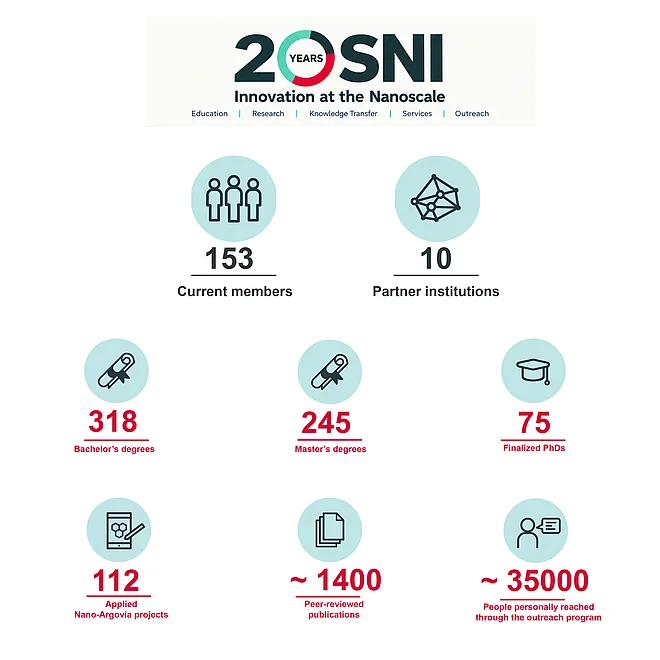
On November 17, 2006, the University of Basel and the Canton of Aargau announced the founding of the Swiss Nanoscience Institute (SNI). They laid the foundation for a successful interdisciplinary network that has since brought together education, research, knowledge transfer, services, and science communication in the nanosciences.
Education and research
Supporting outstanding young scientists has been at the heart of the SNI’s mission from the very beginning. To date, 318 students have earned a bachelor’s degree and 245 a master’s degree in the Nanosciences program at the University of Basel. The SNI PhD School was established in 2012. Since then, 75 doctoral candidates have successfully defended their dissertations.
In addition to basic science projects in the SNI PhD School, the SNI also supports application-oriented research projects through the Nano-Argovia program in close collaboration with industrial companies from Northwestern Switzerland. To date, the SNI has supported 112 Nano-Argovia projects, which have served as an important starting point for innovative developments at numerous companies.
The network’s success is also reflected in its scientific publications: A search on Google Scholar revealed that SNI members have published more than 1,400 papers since the network’s founding. Researchers from various disciplines are thus making a significant contribution to answering fundamental questions at the nanometer scale and developing solutions to application-oriented challenges.
Services and Outreach
Another milestone was the foundation of the Nano Technology Center in 2022. Since then, the two service units – the Nano Imaging Lab and the Nano Fabrication Lab – have made an important contribution to the SNI’s success through their services and their own research. The focus areas of nanoimaging and nanofabrication are also firmly anchored in the SNI strategy published in 2024.
From the very beginning, the SNI has been committed to informing the public about its activities and sparking interest in the natural sciences. Whether through social media, at markets and science festivals, during school visits, or as part of lab tours – the SNI team continues to engage in dialogue between science and society through a variety of formats.
From the very beginning, the network has been dynamic: Today, it has 153 members and includes ten partner organizations: the University of Basel, the FHNW School of Life Sciences, the FHNW School of Engineering and the Environment, the Paul Scherrer Institute, CSEM Allschwil, the Department of Biosystems at ETH Zurich in Basel, the two technology transfer centers ANAXAM and Swiss PIC, as well as the Hightech Zentrum Aargau and Basel Area Business & Innovation.
Thank you
Behind these successes are people who are deeply committed to the SNI. We extend our heartfelt thanks to the Canton of Aargau and the University of Basel, whose ongoing financial support forms the foundation for the SNI’s work.
We also thank the two Argovia professors and all the researchers who, with their innovative ideas and projects in the PhD School and the Nano-Argovia program, are gaining new insights and developing concrete solutions to societal challenges. And last but not least, our thanks go to the administrative team, which coordinates and makes the network’s diverse activities possible.
Many thanks to everyone who has shaped and helped build the SNI over the past 20 years. We look forward to many more exciting years full of new ideas, discoveries, and innovations – because at the SNI, small things make a big impact!