
/ News, Research, Erfolgsgeschichten
Better dental reconstructions: New insights into dental zirconia
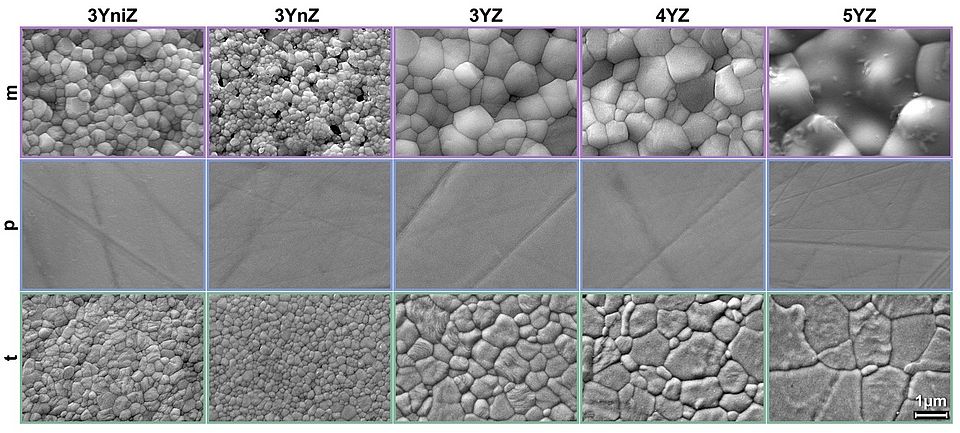
Researchers from the SNI network have gained new insights into the factors that significantly influence the surface and mechanical properties of dental zirconia. In the scientific journal Ceramics International, they report that polishing increases the strength of the samples and subsequent heat treatment creates a defined surface with exposed crystal grains. The yttria content also plays a decisive role in determining the material’s properties.
Thanks to its convincing combination of natural aesthetics and high mechanical stability, zirconia is becoming increasingly important for dental implants, single crowns, and fixed dental prostheses. Depending on the requirements, the ceramic material is stabilized with small amounts of yttria. However, the mechanisms influencing its surface and material properties are still not fully understood.
In the recently published study, the researchers systematically investigated five different zirconia materials with varying yttria content. The team from the University Center for Dental Medicine Basel UZB and the School of Life Sciences FHNW also analyzed three types of surface processing: sintered, polished, and polished followed by heat treatment. In addition to morphological properties such as grain size and surface roughness, the research group led by Professors Nadja Rohr, Géraldine Guex (both UZB), and Michael de Wild (FHNW) assessed the crystal phase composition as well as the materials’ biaxial flexural strength and scratch resistance.
The results clearly show that both the yttria content and the type of surface processing are crucial for the material properties. In particular, the interplay between crystallographic structure, grain boundaries, grain size, and surface roughness determines the stability and performance of zirconia.
Polishing followed by heat treatment successfully removed macroscopic structures and produced surfaces with clearly defined grain sizes in the mid-nanometer range. At the same time, the strength of the specimens increased significantly.
However, the researchers emphasize that the polymorphic behavior of zirconia remains highly complex and not yet fully understood. This is due to the interactions between the properties of the raw material and the production processes, which ultimately determine the quality of the final product.
The project was funded by the Swiss Nanoscience Institute as part of its Nano-Argovia program, which supports knowledge and technology transfer between academia and industry.
Original publication:
Zirconia in dentistry - understanding the effects of yttria-content, surface processing and heat-treatment on surface and mechanical properties
Nadja Rohr, Murat Pinto, Tiffany Moraz, Romy Marek, Anne Géraldine Guex, Michael de Wild
Ceramics International 2026, https://doi.org/10.1016/j.ceramint.2026.01.447