
/ News, Research, Portraits
Christoph Gerber — a life devoted to the nanosciences
![[Translate to English:] Video über das Rasterkaftmikroskop mit Christoph Gerber](https://nanoscience.unibas.ch/fileadmin/_processed_/a/1/csm_AFM_-_A_Swiss_success_story_with_three_letters_and_hundreds_of_applications_4ac85c4830.png?1772462749 "AFM - A Swiss success story with three letters and hundreds of applications")
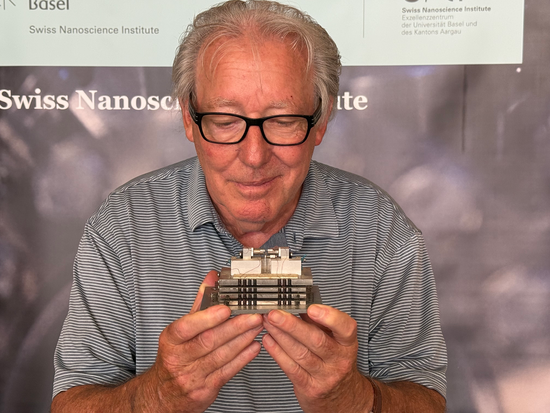
Forty years ago, Gerd Binnig, Carl Quate and Christoph Gerber published their invention of the atomic force microscope. Even at the age of 83, Gerber continues to share his enthusiasm for this special microscope, which was instrumental in allowing scientists to explore the nanoworld.
Almost every Tuesday, Prof. Christoph Gerber can be found at the Department of Physics of the University of Basel. At 83 years old, he is still fascinated by research into and the applications of cantilevers and atomic force microscopes. For over 40 years, the prizewinning physicist and honorary member of the Swiss Nanoscience Institute (SNI) has passed this enthusiasm on to his colleagues — and he continues to play a key role in bringing the fascinating world of the nanosciences to a wider audience. As a child, however, he would never have dreamt that he would one day stand in the limelight like other great scientists.
Fascinated by books
Gerber was born in Basel in 1942. Even as a child, he had an affinity for the University of Basel, as he would often play on the lawns in front of the main building on Petersplatz. From an early age, he also discovered his passion for books and spent many nights under the bedcovers reading by flashlight.
As well as literature for young readers, he was particularly fascinated by biographies of natural scientists. “Characters like Michael Faraday, who — as a bookbinder — would not only bind but also read the findings of great scientists and then try them out experimentally, made a huge impression on me,” he recalls.
For Gerber, however, there was no question of becoming a scientist initially, and he instead opted for an apprenticeship as a precision engineer. After completing his training, he successfully applied to the Swiss company Contraves, which was known for, for example, instruments and measurement systems in the fields of precision engineering, optics and electronics. Soon after starting his job, he was sent to Sweden to take up a position as group leader.
Success as part of a team
In 1966, Gerber moved back to Switzerland to work at the IBM Research Laboratory in Rüschlikon. This marked the beginning of an exciting and intense period of his life. He worked closely with the future Nobel laureate Dr. Heinrich Rohrer — initially on various topics relating to low-temperature physics as well as on structural phase transitions. After the young physicist Dr. Gerd Binnig joined the team, Gerber would soon concentrate entirely on the development of the scanning tunneling microscope (STM). Day and night, he tinkered away with a view to overcoming the technical difficulties affecting this new kind of microscope.
The breakthrough came in 1981. Specifically, the team of scientists — comprising Rohrer, Binnig and Gerber as well as Edmund Weibel, a research assistant who subsequently joined the team — found that a tunnel current flows between the nanoscale tip of the microscope and the sample being measured, and that this current decreases exponentially with increasing distance. As the microscope tip scans the surface of a conductive material, the tunnel current therefore varies in response to elevations or depressions. These variations can then be used to generate an atomic image of the surface.
Reactions to this news varied widely in the world of science. “Whereas the doors opened for further research funding at IBM, the renowned journal Physical Review Letters rejected the publication,” says Gerber. Its rationale was that the tunneling effect had been known about for some time and that, although this new kind of microscope was a technical marvel, it did not represent a scientific innovation.
A widely cited publication
The team of scientists were not discouraged, however, and pushed ahead with their research. In 1986, Binnig and Rohrer were awarded a Nobel Prize for the development of the scanning tunneling microscope, which had by then reached an advanced stage. The same year, Gerber published a paper on the invention of the atomic force microscope (AFM) together with Professors Gerd Binnig and Calvin Quate (Stanford University, California, USA). “We were irritated that the STM could only be used to analyze conductive surface structures,” says Gerber. “With that in mind, we pursued the idea of measuring not the tunnel current but rather the whole conglomerate of interatomic forces that act on the tiny microscope tip as it scans a sample.”
This approach, which now dates back 40 years, has proven to be a real success story. To this day, the publication in Physical Review Letters (PRL) in 1986 is one of the most frequently cited articles from the journal.
Looking back, Gerber says: “In the field of nanotechnology, which was still in its infancy in those days, the invention of atomic force microscopy led to a paradigm shift in the understanding and perception of matter at its most fundamental level. The AFM can depict, analyze and manipulate materials in unprecedented resolution and can be combined with a whole host of other technologies. This makes it one of the most powerful and versatile tools in nanoscience and nanotechnology, opening up new avenues in physics, chemistry, biology and medicine. The AFM’s capabilities continue to inspire researchers all over the world.”
Cantilever probes as a new object of research
The publication in PRL was followed by some exciting years for Gerber. He spent a total of four years at the IBM Research Laboratory, Stanford University in California, and the IBM Lab at LMU Munich, trained numerous colleagues on using the new microscopes, and shared tips with them that he had acquired throughout the development process. He gave numerous plenary and keynote lectures at international conferences and universities throughout the world and, as a research staff member at IBM, supervised numerous doctoral students and postdocs who then went on to further develop atomic force microscopy in their various careers.
Ever since the development of the atomic force microscope, nanomechanics has been the cornerstone of Gerber’s research. Together with his team, he has developed sensors based on the cantilevers of the atomic force microscope. These “cantilever array sensors” detect highly sensitive biological interactions. The cantilevers are first functionalized with specific molecules. When molecules from the test solution bind to them, this causes nanoscale deflections that can be detected. “The sensors are used for rapid, low-cost disease diagnostics as cancer markers or in the early detection of sepsis from patient blood without cultivation. They are impacting medical diagnostics by surpassing today’s time-consuming gold standards,” says Gerber.
A move to Basel
In the late 1990s, a new era began for Gerber. Soon after the atomic force microscope was developed, he was in contact with Professor Hans-Joachim Güntherodt from the University of Basel, who wanted to use the new microscopes for the analysis of metallic glasses in atomic resolution.
Güntherodt was convinced of the benefits of the new technology from an early stage and was keen to collaborate. Together with Gerber, he developed the idea of a nano center in Basel. The call for proposals for National Centers of Competence in Research (NCCRs) by the Swiss National Science Foundation (SNSF) was the perfect opportunity. His colleagues at the University of Basel were quickly convinced that the future belonged to the nanosciences. In 2001, the NCCR Nanoscale Science was then established with the University of Basel as the lead institution. As a result, Gerber retired from IBM and invested all his energy and motivation into his new roles as project leader for cantilever probes and director of scientific communication for the NCCR.
In 2006, the NCCR Nanoscale Science then evolved into the Swiss Nanoscience Institute (SNI), which is funded by the University of Basel and the Canton of Aargau. Within this interdisciplinary network, which drives forward nanoscience training and research in Northwestern Switzerland, Gerber has been involved in the Executive Committee and various research projects. In 2017, he was awarded honorary membership of the SNI.
Collaboration, passion and persistence as key factors for success
Thanks to his pioneering work in the nanosciences, Gerber himself has become a highly esteemed and internationally renowned scientist. He has been awarded various academic titles and memberships and has received numerous honors and prizes, including honorary doctorates from the Universities of Basel and Twente and honorary professorships in St. Andrews and Beijing. In February 2012, he received the Lifetime Achievement Award from the journal Nature, and in 2016, he was awarded the Kavli Prize in Nanoscience together with Gerd Binnig and Carl Quate. Gerber was presented with the Albert Einstein World Award of Science from the World Cultural Council in 2023 and selected as a Citation Laureate in Physics by Clarivate in 2024 — to name just a few of his many distinctions.
Christoph Gerber emphasizes that science is a collaborative endeavor: “It is the culmination of more than 50 years of passion, commitment and perseverance, and the unabated urge of curiosity.” When asked about his career credo he says: “It’s also very important to question and challenge dogmas, to go your own way and to work hard on achieving your vision. The teams of mentors, colleagues and supporters have also played a crucial role in my journey.”
At 83, Gerber still has the energy and motivation to stay active — not only in science, with his weekly flying visit to the Department of Physics to keep in touch with the researchers who are successfully continuing his work, but also in his private life, where he still has some ambitious goals. For example, he regularly plays golf and strives to emulate John Bardeen, whose hole in one was worth almost as much to him as his two Nobel Prizes in Physics. In winter, Gerber also has his skis at the ready — although he’s been saying for a few years that this will be his last season on the slopes.