

/ News, Research
Light-driven proteins in artificial membranes — new method for biohybrid systems
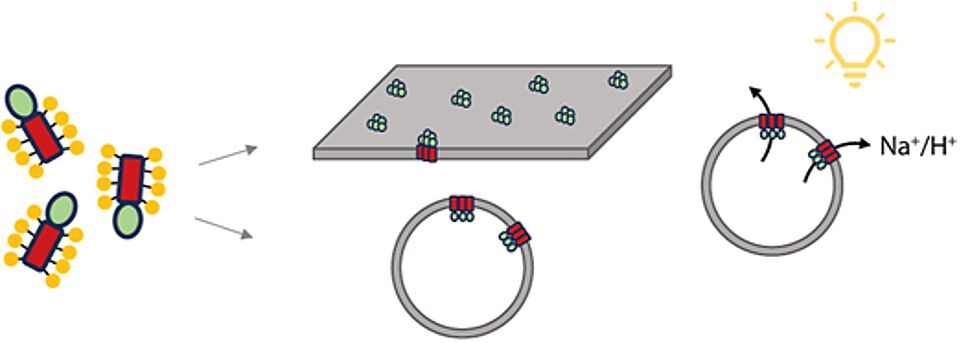
Researchers from the SNI network have developed an innovative method of integrating light-driven membrane proteins into artificial polymer membranes. This achievement marks an important step toward the development of biohybrid systems that convert light energy directly into chemical energy — with potential applications in sensing or energy harvesting. The study was recently published in the scientific journal Biomacromolecules.
Light-driven membrane proteins are key components in biohybrid systems, as they can convert light energy into ion gradients, enabling energy conversion or sensory applications. While their integration into natural lipid membranes is well studied, embedding them into artificial polymer membranes has proven challenging. Although polymer membranes are mechanically more stable and durable than lipid membranes, their physicochemical properties (e.g. thickness, flexibility) make protein incorporation difficult.
In their study, researchers led by Prof. Cornelia Palivan (Department of Chemistry, University of Basel) and Dr. Richard Kammerer (Paul Scherrer Institute PSI) successfully integrated the light-driven sodium-proton pump protein KR2 from the bacterium Krokinobacter eikastus into flat and spherical polymer membranes made of PMOXA-b-PDMS.
“We used a mild detergent (DDM) that locally softens the polymer membrane without destroying its structure. This allowed us to successfully incorporate KR2 without compromising its functionality,” explains Dr. Piotr Jasko, first author of the study and former doctoral student at the SNI PhD School.
Using surface-sensitive measurement techniques and fluorescence methods, the researchers confirmed that KR2 continued to transport ions when exposed to light. A fluorescent marker also enabled the quantitative determination of protein incorporation.
“Our method works for both flat (2D) and spherical (3D) polymer membranes and could also be applied to other membrane proteins and polymer membranes,” summarizes Cornelia Palivan. “This paves the way for the development of biohybrid membranes that can use light energy for ion transport, sensing or energy conversion.”
Originalpublikation:
Functional Insertion of the Light-Induced Ion Pump KR2 into Block Copolymer Membranes
Piotr Jasko; Moritz S. Muthwill; Maryame Bina; Daniel Frey; Cora-Ann Schoenenberger; Richard A. Kammerer, Cornelia G. Palivan
Biomacromolecules (2026) 27 (8): 5449–5460.