

/ News, Research
Promising approach in cancer therapy: Activating active ingredients directly at the tumor
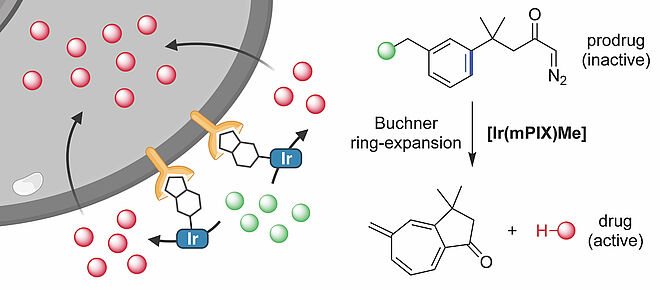
Researchers from the SNI network have used a chemical reaction that does not occur naturally to activate active ingredients directly at a tumor. This could make cancer treatment more gentle and effective. The technology is based on what is known as bioorthogonal catalysis. It uses artificial metal compounds to convert harmless drug precursors (known as prodrugs) into their active form only at the desired site in the body.
Conventional chemotherapy treatments often attack not only cancer cells but also healthy tissue, leading to severe side effects such as hair loss or nausea. The team led by Prof. Dr. Thomas Ward from the Department of Chemistry and the Swiss Nanoscience Institute (SNI) at the University of Basel is therefore pursuing an approach that uses artificial metal compounds as catalysts, which specifically bind to tumor cells and then convert so-called prodrugs into the active ingredient at the tumor site.
Artificial chemical reaction
In a study recently published in the “Journal of the American Chemical Society”, the researchers presented the so-called Buchner-Ring expansion to convert the caged drug into the active drug. This is made possible by the use of a specific iridium-based catalyst designed to specifically bind to tumor cells.
The iridium catalyst is functionalized with an inhibitor for a tumor protein (hCA IX). The inhibitor essentially acts as an address label, causing the catalyst to selectively bind to tumor cells that overexpress hCA IX on their surface. Once the catalyst is bound to the tumor cell and a prodrug is added, a reaction cascade occurs: an aromatic ring in the prodrug is expanded, thereby releasing the active ingredient. This reaction is highly selective and works even at extremely low concentrations.
“As part of the study, we tested the method with the active ingredient epirubicin, a commonly used chemotherapeutic agent,” explains Dr. Damian Graf, who conducted this research as part of the SNI PhD School. “By coupling the catalyst to an inhibitor of the tumor protein hCA IX, we were able to specifically confine the release of the active ingredient to cancer cells.”
Potential for the future
The results open the door to a new generation of cancer therapies that are more precise, less invasive and less toxic. “In the long term, this technology could fundamentally change the way we treat cancer,” explains Thomas Ward, who, along with his team, conducts research on organometallic compounds. “Since the catalyst can be combined with various active ingredients, the method offers a high degree of flexibility. It could also pave the way for further applications in so-called bioorthogonal chemistry—a growing field that enables chemical reactions in living systems without disrupting natural processes.”
The next steps for the further development include additional testing in preclinical models to prepare the method for clinical use.
Original publication:
Catalytic Uncaging of Anticancer Drugs via a Buchner Ring Expansion
Damian Alexander Graf; Nicole Rathfelder; Boris Lozhkin; Thomas R. Ward
Journal American Chemical Society (2026)
https://doi.org/10.1021/jacs.6c14207
Further information: