

/ News, Research
What happens to nanoparticles when they enter the bloodstream?
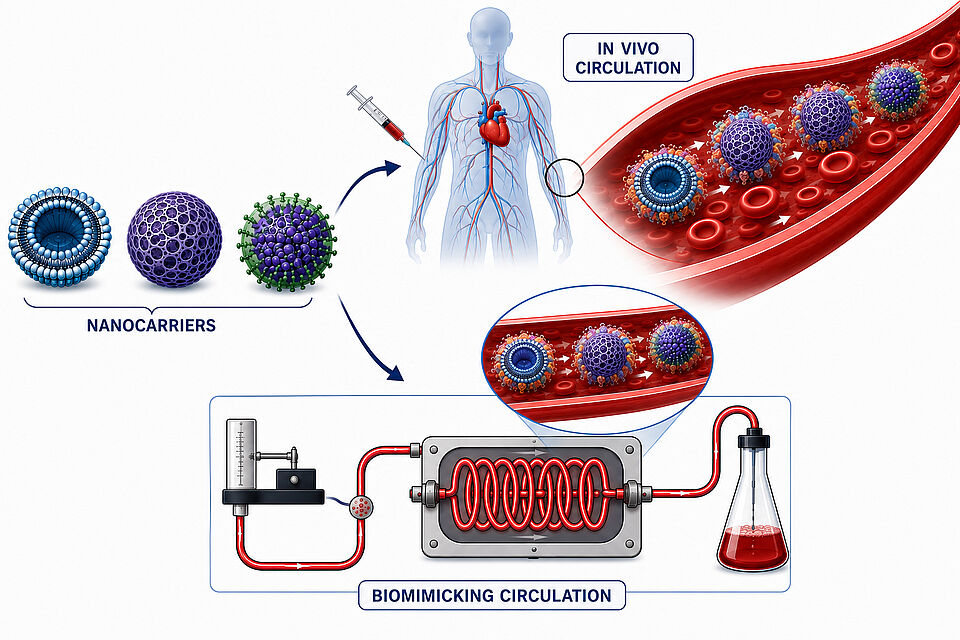
Researchers from the SNI Network have developed a dynamic artificial circulatory system that mimics the natural blood flow and protein conditions in the human body. Using this system, they investigated how various soft nanoparticles – such as liposomes or polymer nanoparticles – behave when exposed to shear forces and blood proteins. The study, a collaboration between the University of Applied Sciences and Arts Northwestern Switzerland (FHNW) and the University of Basel, aims to advance the development of safer and more targeted nanomedicines. The findings were recently published in the scientific journal Advanced Materials Interfaces.
The use of nanoparticles in drug delivery offers key advantages: They can enable targeted drug delivery, protect active ingredients from premature degradation, extend their duration of action in the body and reduce side effects. However, as soon as nanoparticles come into contact with blood, proteins from the blood adsorb onto their surface – forming a so-called protein corona. This corona influences whether the particles are taken up by cells, how they distribute in the body or whether the immune system recognizes and attacks them.
To date, research has primarily focused on the protein coronas of hard nanoparticles, such as gold. Yet many nanoparticles relevant for clinical drug delivery – like liposomes and polymer nanoparticles – are soft and flexible. Their protein coronas differ in composition, deformability and dynamics from those of hard particles, as the material properties influence protein binding. To study these processes under body-like conditions, the team led by Prof. Oya Tagit from FHNW School of Life Sciences developed an artificial venous circulation system. This system simulates shear forces, the constant movement of nanoparticles and a continuous exchange of proteins – mimicking the natural bloodstream.
In experiments with lung cancer cells, the researchers found that the uptake of nanoparticles into cells was significantly reduced by their protein corona. "The protein corona alters the properties of the nanoparticles – depending on the material being studied," explains Anamarija Nikoletić, first author and PhD student at the SNI PhD School. "While all the nanoparticles we examined had a common core of proteins in their corona, they also exhibited material-specific differences.”
Another interesting observation was that lipid-based nanoparticles interacted not only with soluble proteins, but also with membrane-associated proteins. This suggests that, during circulation, these nanoparticles may interact or even fuse with cell-secreted extracellular vesicles, further altering their biological identity.
"This study highlights how crucial it is to test nanoparticles under realistic conditions to better understand their behavior in the body. This will help us develop safer and more effective drug delivery systems," emphasizes Oya Tagit.
Original publication:
Nikoletić, A. et al. (2026). Protein Corona Formation on Soft Nanocarriers Under Biomimetic Circulatory Flow. Advanced Materials Interfaces, e70611.
DOI:10.1002/admi.70611
Additional information:
Webpage Biointerfaces: www.nanobiointerfaces.ch