
/ News, Berichte
Resistant vines in times of climate change
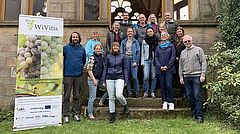
The trinational project WiVitis revolves around sustainable viticulture and concepts that help vineyards tackle the challenges of climate change. Switching over to resistant vine varieties that are adapted to climate change seems an inevitable step. Now, the WiVitis project is collecting data on the stability of the berries’ skins as a key factor in grape health at various locations in the Upper Rhine region and in all weather conditions.
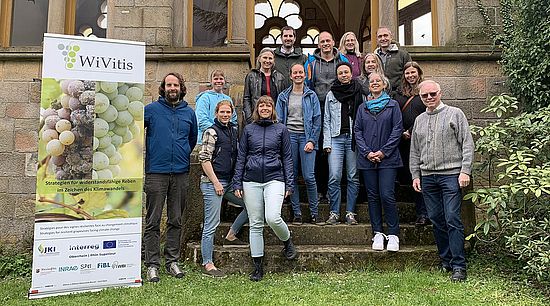
Recently, the project partners from Germany, France and Switzerland got together for a project meeting in order to consolidate strategies for data collection, discuss experimental setups and agree on protocols for the 2024 season.
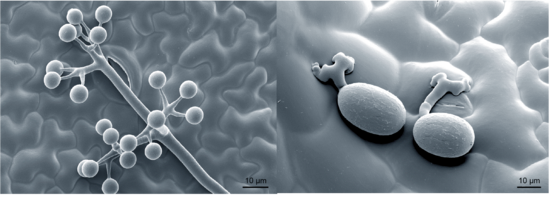
The SNI’s Nano Imaging Lab also forms part of the network of research institutions. With scanning electron microscope images, it provides valuable information on the surface properties of berries of various fungi-resistant vine varieties and the structural differences between the waxes found on their surfaces. In the coming season, the NI Lab will analyze samples of selected vine varieties from various vineyards in the Upper Rhine region.
More information at https://wivitis.wine-science.eu/
Report on project meeting: https://wivitis.wine-science.eu/news.htm
Participating institutions:
Julius Kühn Institute Siebeldingen (JKI), Dienstleistungzentrum Ländlicher Raum Rheinpfalz (DLR RP), Research Institute of Organic Agriculture FiBL, INRAE Grand Est-Colmar Centre, State Viticulture Institute Freiburg (WBI)