

/ News, Research
Fully functional peptides on nanoparticles
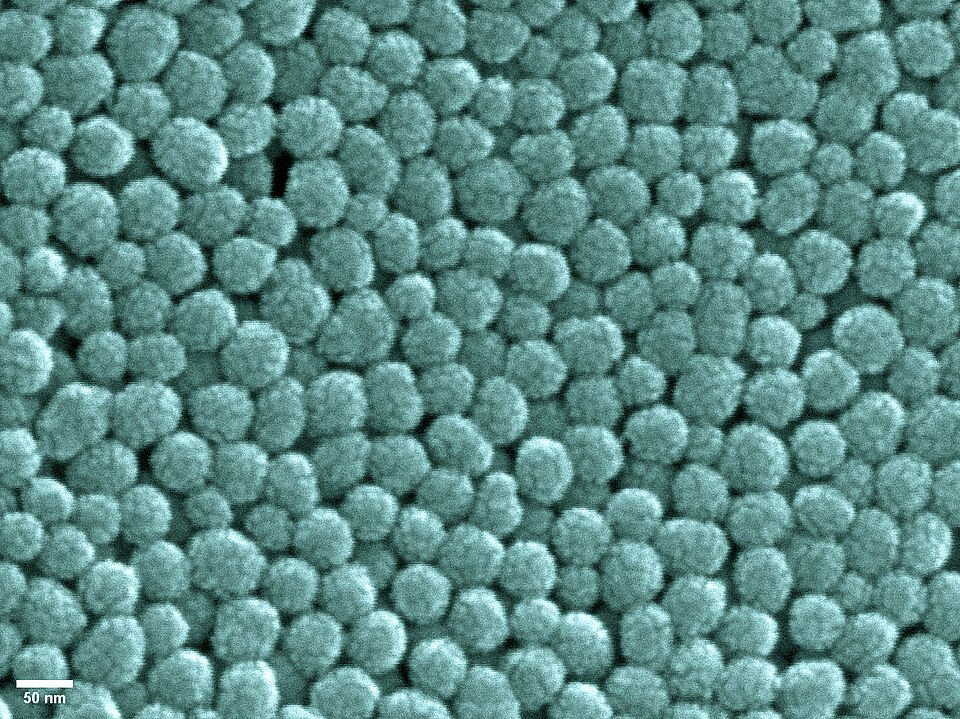
Peptides are promising building blocks for biotechnological and medical applications – but their stability is often problematic. Binding them to nanoparticles can increase the peptides’ stability and can also protect them from degradation. A major challenge, however, is preserving the biologically active three-dimensional structure of the peptides – particularly the α-helix – even after immobilization on the surface of nanoparticles.
Researchers from the SNI network have recently presented a method in the scientific journal Angewandte Chemie International Edition that allows peptides with an α-helix structure to be specifically stabilized on silica nanoparticles.
The researchers achieved this by designing the peptides to regularly contain the amino acid lysine – which then forms a chemical bond with the nanoparticles. The outward-facing side of the peptide helix remains unchanged and is still accessible for interactions with other molecules. The peptides thus retain their function – such as binding to the protein streptavidin – while also being more stable and heat-resistant.
The researchers from the teams led by professors Dr. Patrick Shahgaldian and Dr. Sebastian Wendeborn at the FHNW School of Life Sciences have thereby developed a reliable method for anchoring peptides to nanoparticles while preserving their structure and function. In the future, such hybrid systems could be used in biotechnology, biosensor technology, or in the development of new biofunctional materials.
Original publication:
Induction and Stabilization of Peptide Alpha-Helices on Silica Nanoparticles
Fidel Lozano-Elena, Seyed Amirabbas Nazemi, Patrick Shahgaldian, Sebastian Wendeborn
Angew Chem Int Ed Engl, DOI: 10.1002/anie.8942173